
Korankei with Chiikawa plushies: 4 autumn photo spots, and not dropping them in the crowds
The Momiji Festival, illumination, parking and bus information was checked on the official Asuke Tourism Association site, and Sanshu Asuke Yashiki on its official site, on Nov 13, 2026. Details may change.
This is episode 7 of Chiifan’s X series of Chiikawa plushies traveling around Japan’s autumn-leaf spots. Korankei (香嵐渓) in Asuke, Toyota City, Aichi, is a valley where about 3,000 maple trees turn color. You walk the paths along the Tomoe River and up the stone steps to a temple. On November weekends it gets very crowded, so the rule here is: take your plushie out only away from the flow of people, and never set it at the river’s edge or partway up the steps. This time the three wear matching zip-up hoodies.
The plushie images on this page are AI-generated travel scenes that Chiifan made with San-Arrow’s product photos of the “Potetama” plushies as a reference. They are not photos taken at the places and may differ from how the places really look. © nagano / chiikawa committee
- Place
- Korankei, Asuke-cho, Toyota City, Aichi
- Nearest bus stop
- “Korankei” (about 40–50 min by Meitetsu Bus from Meitetsu Toyotashi Station, and other routes)
- Usual peak
- Mid to late November
- Momiji Festival 2026
- Nov 1–30. Light-up every day from sunset to 21:00
- Admission
- Free (parking: ¥1,000 per car)
- Rule to know
- Take your plushie out only away from the crowds; never at the river’s edge or on the steps
The path facing Taigetsukyo Bridge: the three looking at a vermilion bridge and maples
Korankei’s best-known view is the vermilion bridge Taigetsukyo (待月橋) over the Tomoe River, with the maples of Mt. Iimori (飯盛山) behind it. Put the three on a bench beside the path, away from the river, and shoot from diagonally in front at their eye level: you get their faces with the bridge and leaves behind them. The benches in the images are just scenes we imagined; there may not be the same spot.
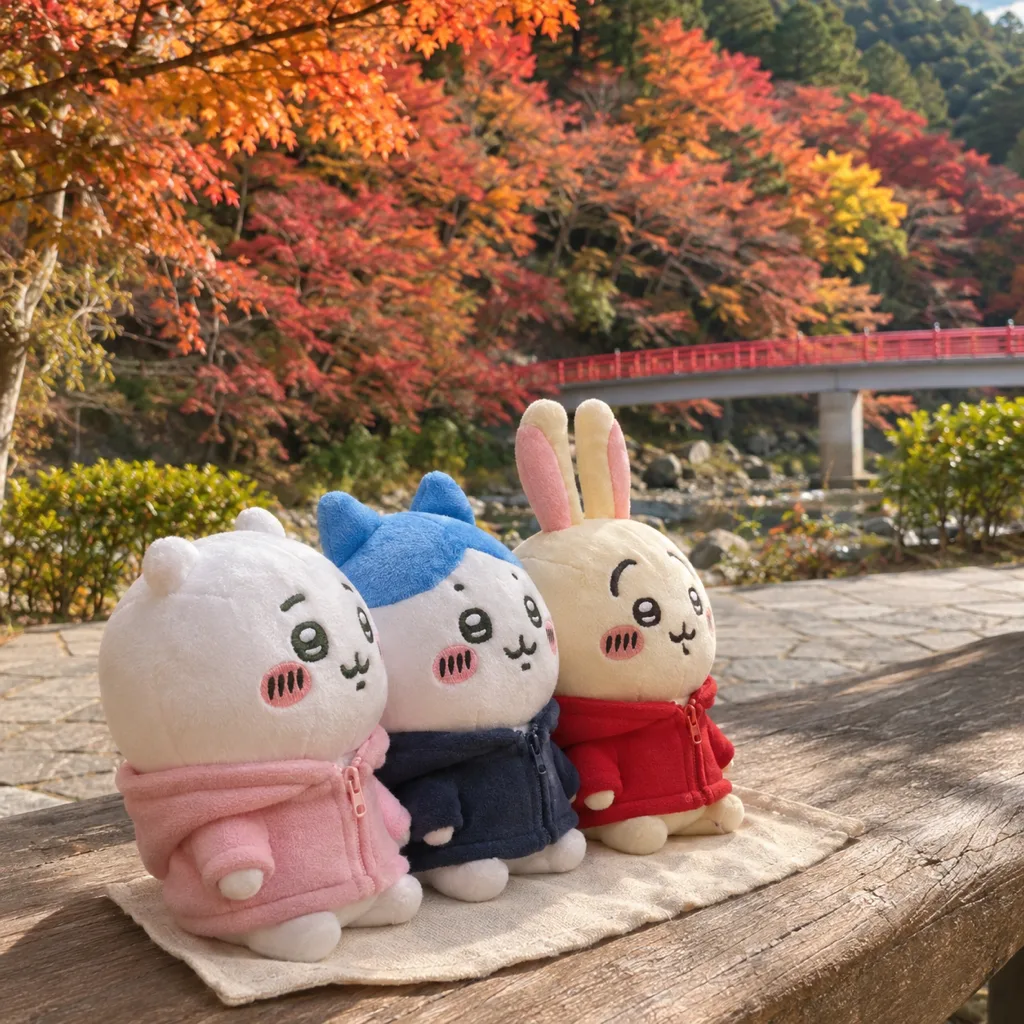
- The riverbank is rocky, and a dropped plushie is hard to get back. Don’t set them on the river’s edge, stone walls or the bridge railing.
- If you set them down, lay a handkerchief on a flat spot away from the river and sit them in the middle. On busy days, don’t hold the bench for long: shoot and make room.
The stone steps to Kojakuji: looking up at Hachiware in a maple tunnel
The maples of Korankei are said to have started in 1634, when the monk Sanei of Kojakuji (香積寺) temple planted them along the approach. Around the stone steps up to the temple, maples cover you overhead.
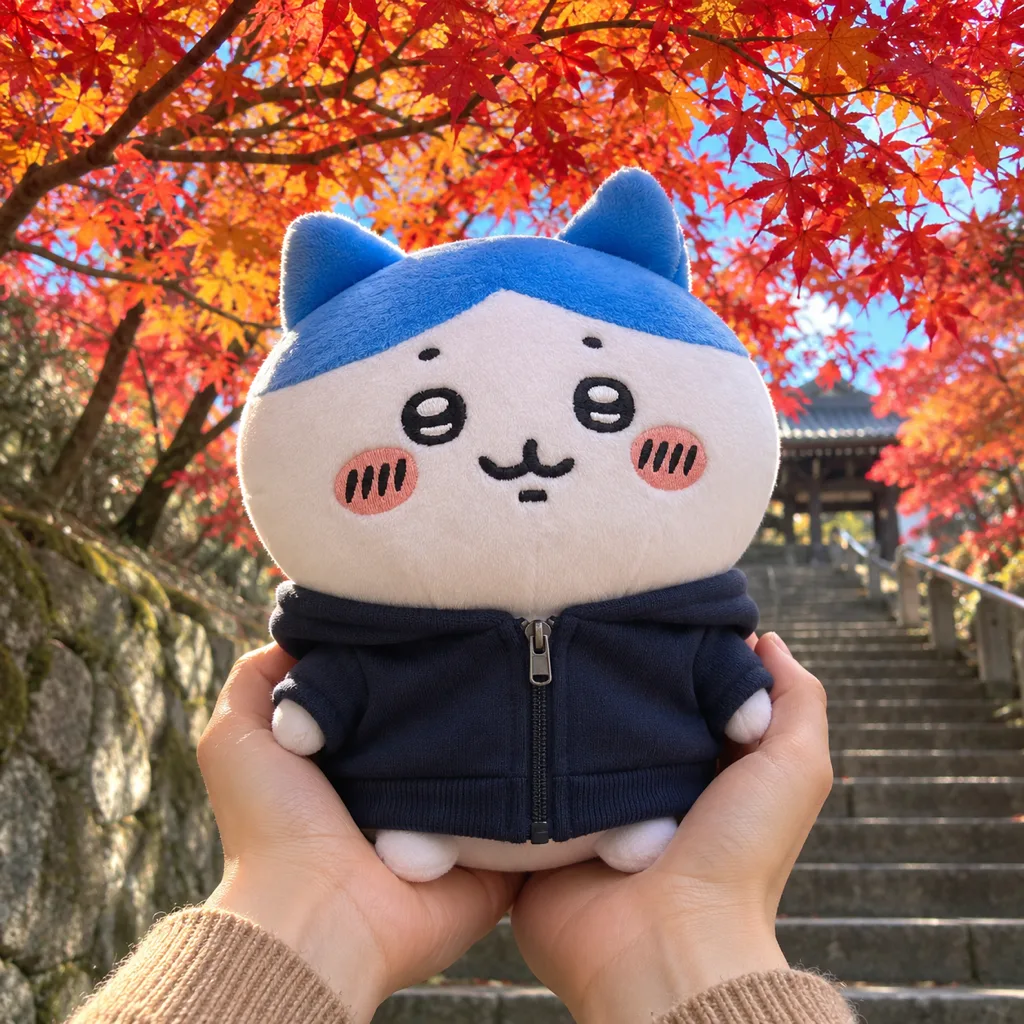
- Hold the plushie up with both hands and shoot from below, as if looking up: the background becomes just sky and maples.
- Don’t stop partway up the steps. Shoot at the top, or at a wide spot at the side of the path.
- When you lift it, use both hands and cup it from underneath, not with one hand.
The night light-up: glowing river and maples, from the body bag’s window
During the Momiji Festival, Mt. Iimori is lit up every day from sunset to 21:00, and the light reflects on Taigetsukyo Bridge and the Tomoe River. On November weekends, about 1,000 bamboo lanterns also line the approach to Kojakuji from 18:00 to 20:30 (not on rainy days).
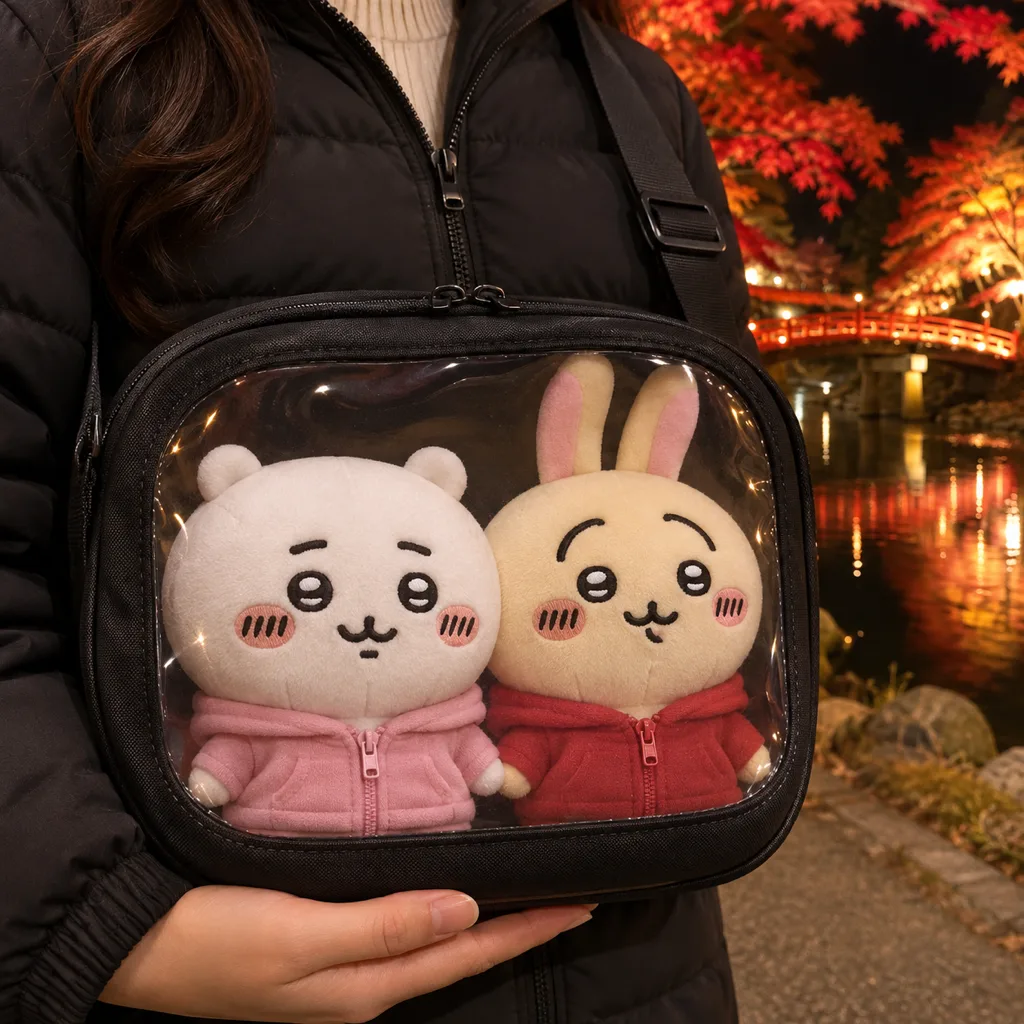
- A plushie dropped on a dark path is hard to find, so at night we suggest shooting it while it stays in the bag. With a clear window on the front, you get the glowing maples without taking it out.
- From sunset until early morning, the path up to the top of Mt. Iimori is closed (you can still go up as far as the Kojakuji grounds).
- If you stay into the evening, check the last bus home first. Day-by-day bus changes are in the access section below.
A rest on a teahouse bench seat: next to Asuke’s gohei-mochi
At the restaurant “桧茶屋” in Sanshu Asuke Yashiki (三州足助屋敷), inside Korankei, you can eat mountain-village food such as gohei-mochi (grilled rice cakes with miso sauce), salt-grilled sweetfish and soba (last order: 15:30 on weekdays, 16:30 on weekends and holidays). The red-covered bench seat and plate in the image are imagined.
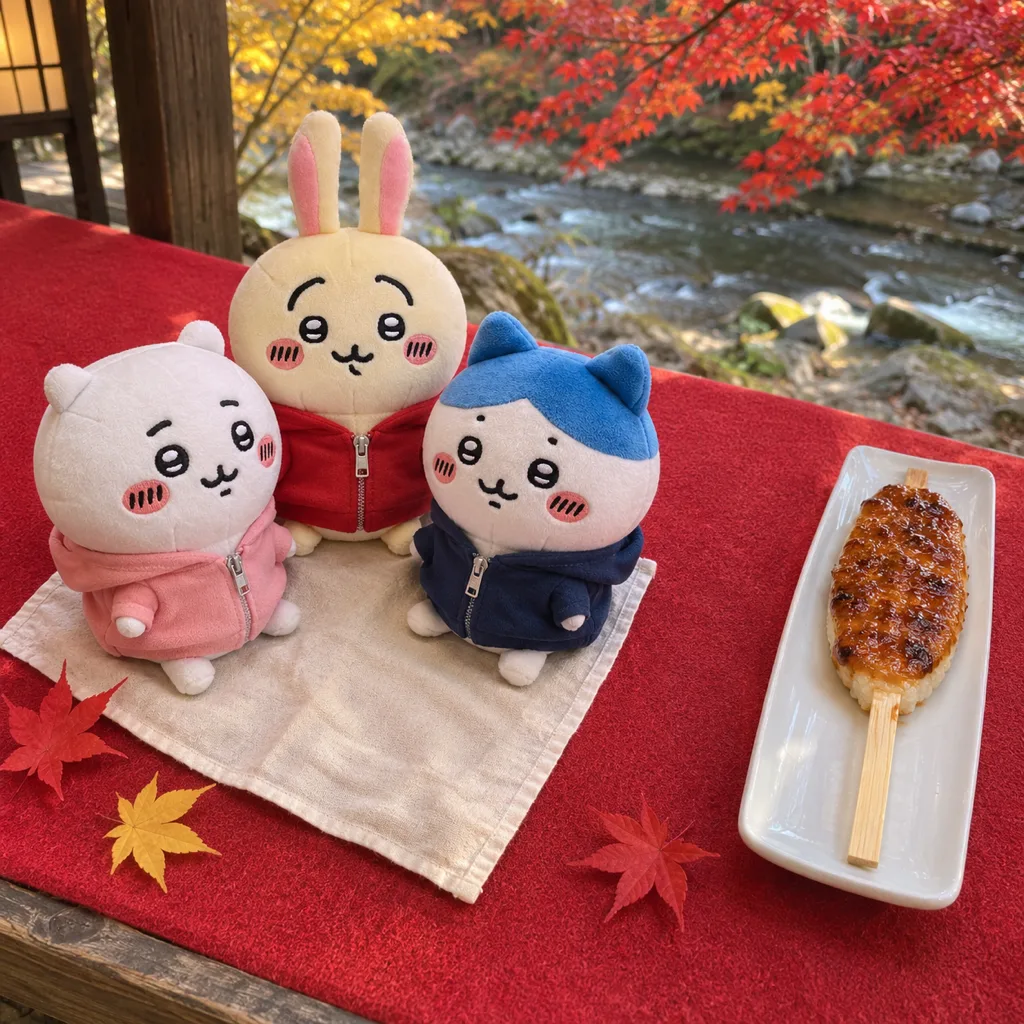
- Miso sauce is hard to wash out of plushie clothes, so keep the plate a hand’s width to the side.
- Inside the restaurant or on its bench seats, ask the staff first whether photos are OK, and keep other customers out of the frame.
Korankei autumn leaves and the 2026 Momiji Festival: Nov 1–30
About 3,000 maples of 11 kinds are said to turn color at Korankei. Aichi Prefecture’s tourism site Aichi Now gives the usual peak as mid to late November. It shifts from year to year, so check the Asuke Tourism Association or social media before you go. The 71st Korankei Momiji Festival runs from Nov 1 (Sun) to Nov 30 (Mon), 2026.
- Light-up (Mt. Iimori)
- Every day, sunset to 21:00 (no extension)
- Bamboo lanterns at Kojakuji
- Weekends Nov 1–29, 18:00–20:30 (about 1,000; not on rainy days)
- Wish candles
- Weekends Nov 7–29, 18:00–20:30 (on the Tomoe riverbank; ¥500 per candle in a glass holder; not on rainy days, and entry to the riverbank may be limited)
- Admission
- Free
- Parking
- ¥1,000 per car (no reservations)
- Sanshu Asuke Yashiki
- Adults ¥300, elementary to high school ¥100 (9:00–17:00, last entry 16:30; open every day in November)
Getting to Korankei: buses from Toyotashi, Josui or Higashi-Okazaki
According to the Asuke Tourism Association, these are the train-and-bus routes. Get off at the “Korankei” bus stop.
- From Meitetsu Toyotashi Station
- Meitetsu Bus (for Asuke), about 40–50 min (depends on traffic)
- From Josui Station (Meitetsu Toyota Line)
- Toyota Oiden Bus (Sanage–Asuke Line), about 60 min
- From Meitetsu Higashi-Okazaki Station
- Meitetsu Bus (for Asuke), about 70 min
- Nov 14, 15, 28 and 29 (Sat/Sun): Oiden Buses from Josui toward Korankei stop at “Asuke Ohashi”. Korankei is about 10 min on foot from there.
- Nov 21–23 (three-day weekend): Oiden Buses leaving Josui in the 11:00–18:00 hours stop at “Nishi-Nakagane” and don’t reach Korankei. On these three days, the last Oiden Bus from Korankei to Josui is at 18:08.
- Meitetsu Bus: the timetable changes from Nov 14 (special timetable on weekends and holidays).
- If you want to see the night light-up, check the time of your bus home first. There are normally no buses back to Higashi-Okazaki after 19:00 on weekdays.
- On weekends and holidays in November, traffic jams can make the trip take more than two hours, and the Asuke Tourism Association recommends coming on a weekday.
Coming from far away: stay in Toyota/Okazaki or in Nagoya
If you want to arrive early, staying nearby the night before makes things easier. The Toyota and Okazaki area has the stations the buses leave from (Toyotashi and Higashi-Okazaki). If you come by shinkansen and want to visit the Chiikawa stores in Nagoya too, Nagoya is convenient.
- To catch the first bus to Korankei
- Stay in the Toyota or Okazaki area
- Coming by shinkansen and want to travel light
- Stay around Nagoya Station
- To visit Chiikawa Land and Magical Chiikawa Store in Sakae too
- Stay around Sakae
What the plushies wear and use: a zip-up hoodie and a body bag with a window
The hoodies in the images are drawn to match the colors of plushie clothes sold in Japan: pink for Chiikawa, navy for Hachiware and red for Usagi. Korankei is in the mountains and gets cold in the morning and evening, so we drew hoodies for an autumn trip. The Potetama trio is about 13–17 cm tall, so we chose items for plushies of around 15 cm.
- Zip-up hoodie
- A hooded top for plushies of about 15 cm. The front zip opens, so you can layer another top inside. 9 colors: white, black, gray, navy, light blue, purple, pink, red and yellow. The shop says sizes are a guide, since plushies differ in how firmly they are stuffed. In the images, Chiikawa wears pink, Hachiware navy and Usagi red (with the hood down and ears out)
- Plushie body bag with a window
- A nylon body bag with a clear window on the front. About 30 × 22 cm with a 10.5 cm gusset; the window is about 20 × 14.5 cm (about 3 cm deep). The shop says it holds two 10 cm plushies or one 20 cm plushie. Fits a 500 ml bottle, with an inner pocket. Water-repellent but not waterproof. Black or white. Potetama plushies are round, so two may not fit side by side: plan on one, compare your plushie’s width and depth with the window, and check that Usagi’s ears don’t get bent
- The clothes and bags we used come from Japanese online shops on Rakuten, and many of those shops only ship within Japan, so we don’t link to them here. Use the sizes below when you look for similar items.
- Plush bodies differ in how firmly they are stuffed, so treat any size on a product page as a guide.
The plushies in the series: Potetama Chiikawa, Hachiware and Usagi
The plushies in the images are San-Arrow’s “Potetama” (ぽてたまぬいぐるみ) Chiikawa, Hachiware and Usagi. The three are about 13–17 cm tall, so clothes and bags for 15 cm plushies fit them.
- Measure your plushie’s width as well before choosing a bag.
Chiikawa stores on the way: Chiikawa Land and Magical Chiikawa Store at Nagoya PARCO
Nagoya PARCO in Sakae, Nagoya, has Chiikawa Land Nagoya PARCO and Magical Chiikawa Store Nagoya PARCO. If you pass through Nagoya on the way to or from Korankei, you can stop by both.
Plan the trip: tours, kimono rental and travel essentials (KKday)
Tours, kimono rental and travel essentials you can book on KKday for a trip with your plushies. Check the price, what is included and the cancellation rules on each KKday page before you pay.
Japan eSIM, unlimited data
For maps and showing QR tickets on your phone. Check that your phone supports eSIM

Frequently asked questions
When are the autumn leaves at Korankei at their best?
Usually mid to late November (Aichi Now). It shifts from year to year, so check the Asuke Tourism Association or social media before you go.
When is the 2026 Momiji Festival, and is there a fee?
Nov 1–30, 2026, with the light-up every day from sunset to 21:00. Entry to Korankei is free; parking is ¥1,000 per car.
Are the plushie pictures real photos?
No. They are AI-generated scenes from Chiifan’s X series, made with the official product photos as a reference.
Sources
Pages marked (Japanese) are only available in Japanese.