
Miyajima with Chiikawa plushies: 4 autumn photo spots, and not losing them to the sea breeze
Momijidani Park, momiji manju, the Miyajima Night Market and fees were checked on the Miyajima Tourist Association’s official site and announcement, and ferry fares, the Otorii route and travel time from Hiroshima Station on the JR West Miyajima Ferry official site, on Nov 14, 2026. Details may change.
This is episode 8 of Chiifan’s X series of Chiikawa plushies traveling around Japan’s autumn-leaf spots. Miyajima (宮島, also called Itsukushima) in Hiroshima is an island you reach by ferry, then explore along the seaside approach and up into Momijidani, the “maple valley”. It can be windy on the sea and by the shore, so the rule here is: never set your plushie on a railing or the edge of a stone wall; hold it in both hands or keep it in a pouch where the wind is calm. This time the three wear knit tops and hand-knit hats.
The plushie images on this page are AI-generated travel scenes that Chiifan made with San-Arrow’s product photos of the “Potetama” plushies as a reference. They are not photos taken at the places and may differ from how the places really look. © nagano / chiikawa committee
- Place
- Miyajima, Miyajima-cho, Hatsukaichi City, Hiroshima
- Getting there
- About 10 min by ferry from Miyajimaguchi Pier (JR West Miyajima Ferry or Miyajima Matsudai Kisen)
- Usual peak
- Mid to late November (Momijidani Park, per the Miyajima Tourist Association)
- Miyajima Night Market 2026
- Sat Nov 21, 15:00–21:00. Momijidani Park and Daishoin temple are lit up
- Costs
- Ferry ¥400 round trip for adults (¥200 one way) + Miyajima Visitor Tax ¥100 per person per visit. Itsukushima Shrine: adults ¥300
- Rule to know
- Never set your plushie on a railing or stone wall edge; hold it in both hands or keep it in a pouch
The seaside square: the three looking out at the great torii in the sea
Miyajima’s most famous view is the great torii gate of Itsukushima Shrine (厳島神社) standing in the sea. Lay a handkerchief in the middle of a bench in a square away from the water, line the three up and shoot from diagonally to the side: you get the stitches of their knit hats, their profiles, and the torii and the autumn mountain behind them. The bench in the image is just a scene we imagined; there may not be the same spot.
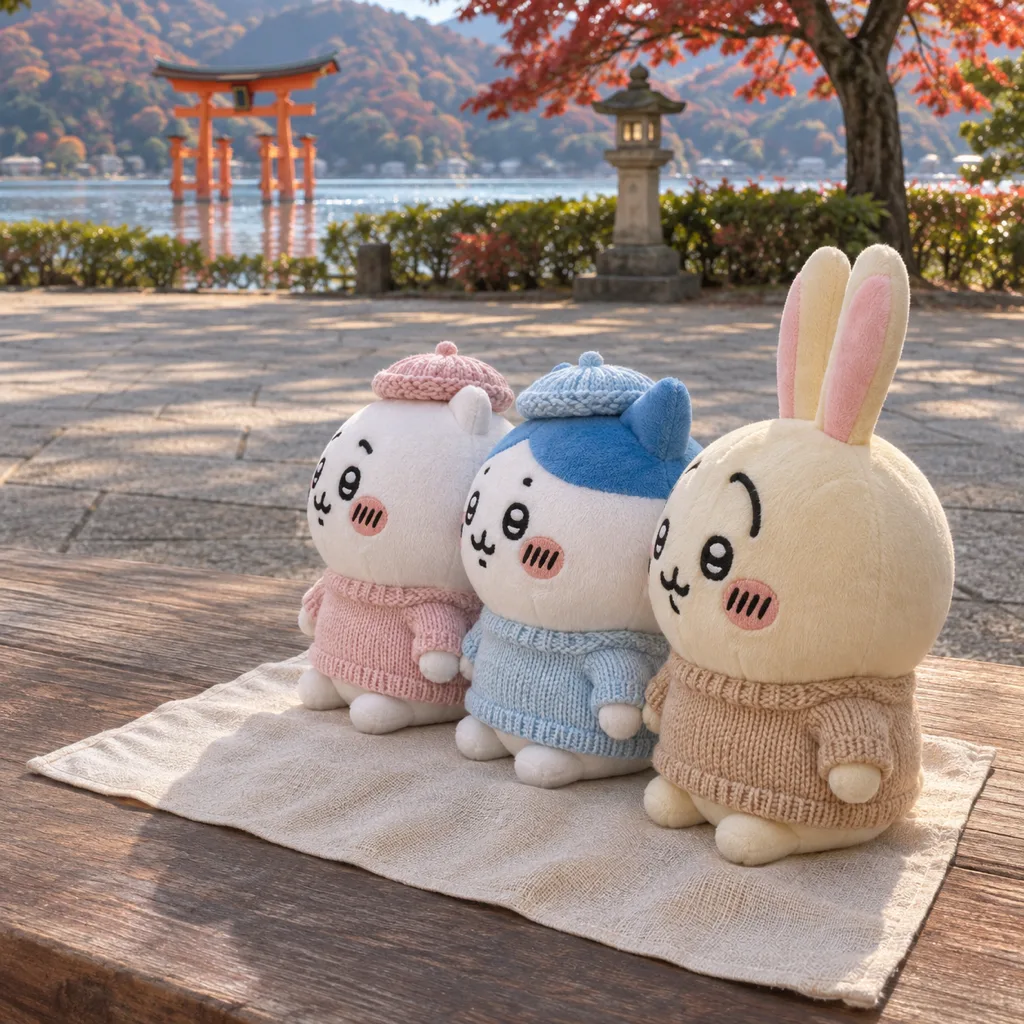
- The shore is often windy, and people tend to stop where the torii is in view. Don’t set the plushies on stone walls or the edge of a fence: use a flat spot away from the sea, in the middle of a handkerchief.
- Once you’ve taken the picture, put them straight back in the pouch and make room for others.
- Low tide times change day by day. If you want the torii standing in a full sea like the image, check the tide times before you go.
On the ferry: Hachiware and Miyajima coming closer
The ferry from Miyajimaguchi Pier to Miyajima takes about 10 minutes. JR West Miyajima Ferry runs its sailings leaving Miyajimaguchi from 9:10 to 16:10 as the “Otorii route” (大鳥居便), which comes closer to the great torii. When the tide is very high the route changes, and in November there are also days when it changes, so check the JR West Miyajima Ferry notices. Miyajima Matsudai Kisen has no Otorii route, so take the JR ferry if you want to get close to the torii. The best moment for pictures is when the island and the torii come closer outside the window.
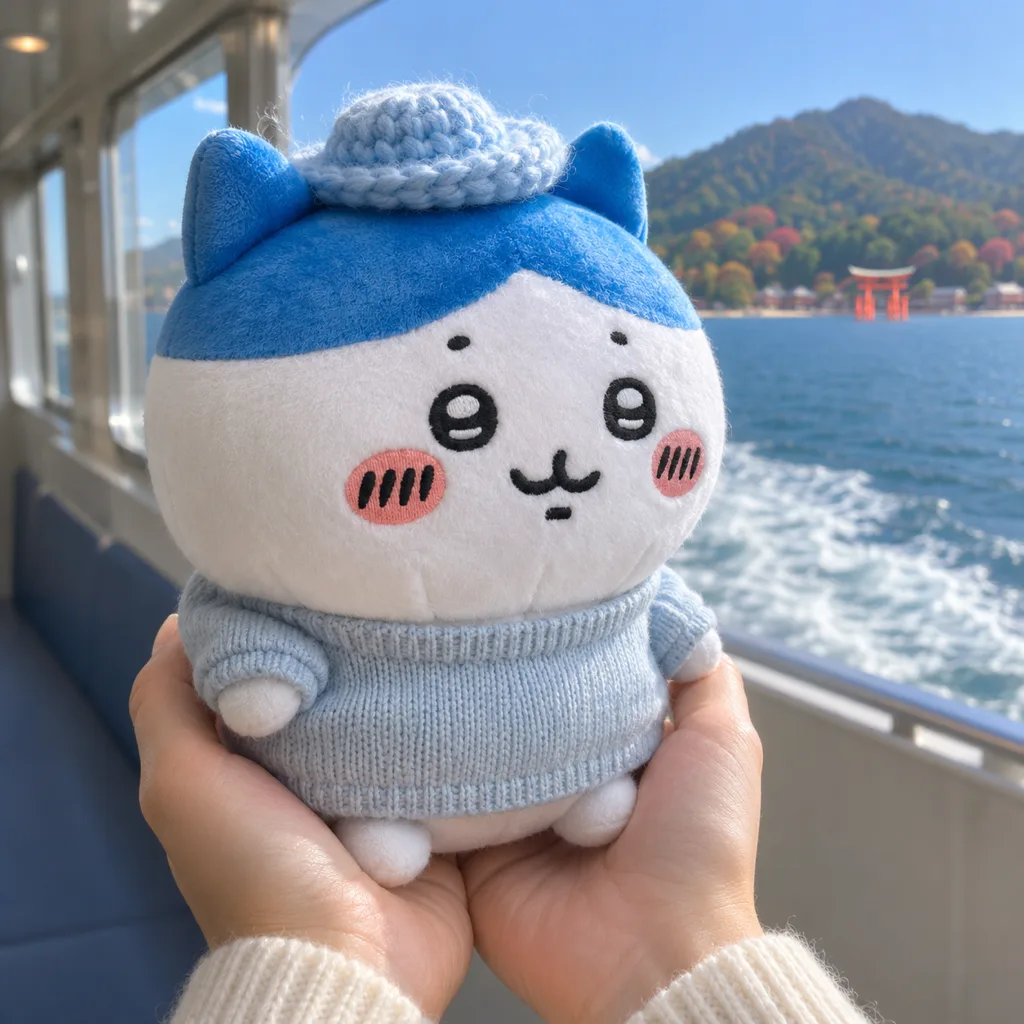
- On the boat, don’t rest the plushie on the railing or the window ledge: hold it from underneath with both hands.
- Hats blow away easily. Take pictures inside the cabin, or take the hat off and put it in the pouch before going out on deck.
- Boarding and getting off is crowded, so keep the plushie in the pouch then.
Momijidani Park: Chiikawa and the maples, through the pouch window
Momijidani Park is a maple spot along the Momijidani River. According to the Miyajima Tourist Association, about 700 maples are planted there (about 560 Japanese maples, about 100 oh-momiji maples and others). Momiji Bridge (もみじ橋) crosses at the entrance. A free bus also runs from the park entrance to Momijidani Station of the Miyajima Ropeway.
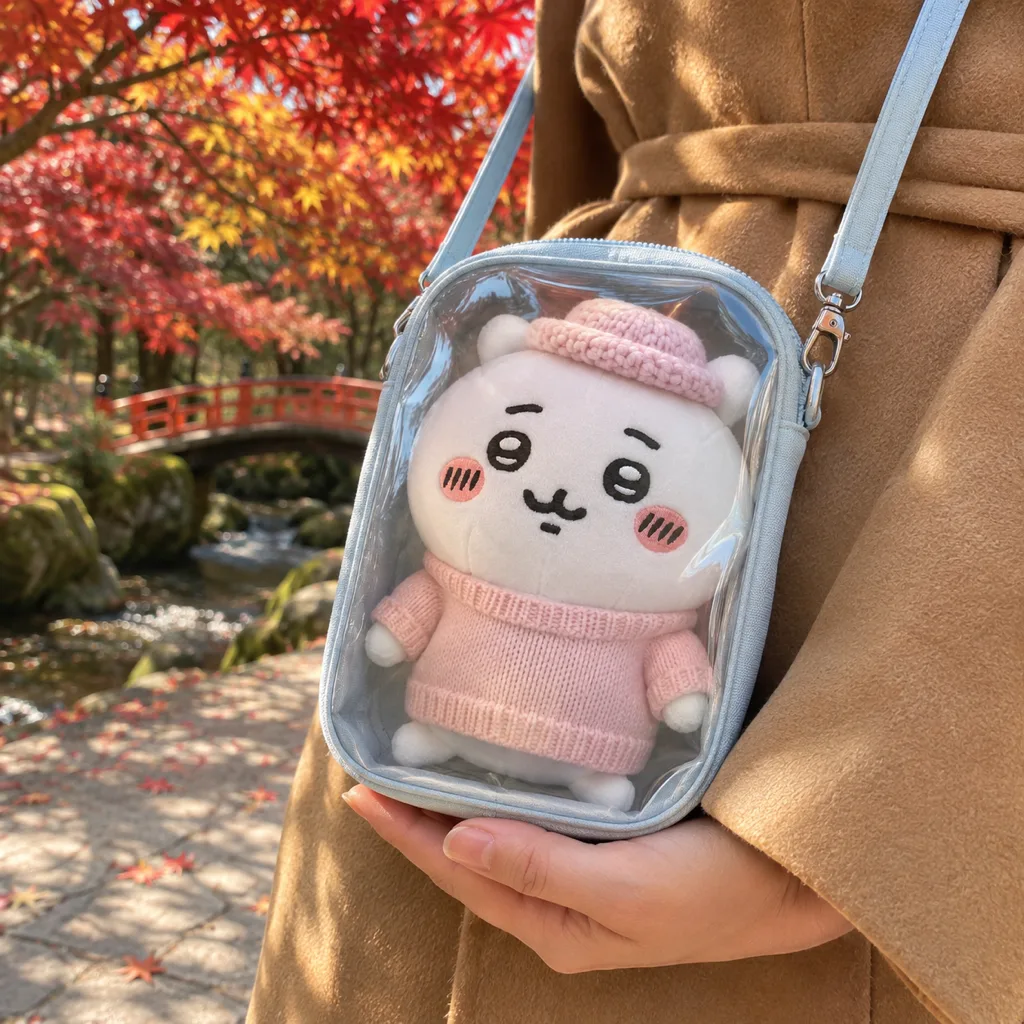
- People keep coming along the paths, so you don’t have to stop each time to take the plushie out: put it in the pouch from the start and wear it across your body.
- With a pouch that is clear on the front, you can photograph it with the maples while the zip stays closed.
- Don’t set the plushie by the stream or on the stones.
A rest on a shop bench seat on the approach: next to momiji manju
According to the Miyajima Tourist Association, momiji manju (maple-leaf-shaped cakes) are said to have started in the late Meiji era, when the confectioner Tsunesuke Takatsu created “maple-shaped baked manju” at the request of the landlady of Iwaso, an inn in Momijidani. Today there are more than 100 kinds with different fillings, sold along the island’s approach too. The bench seat and plate in the image are imagined.
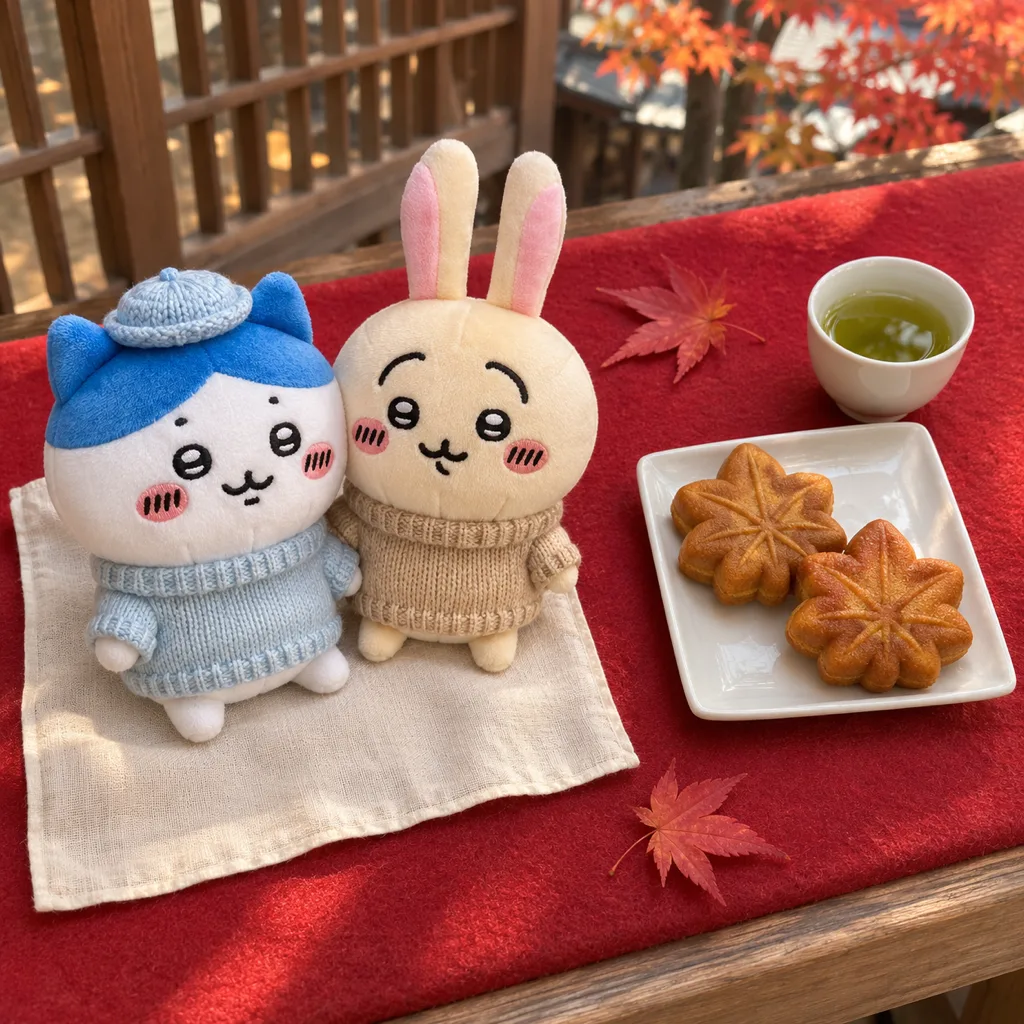
- Crumbs and oil from baked sweets are hard to get out of knit yarn, so keep the plate a hand’s width to the side.
- If you shoot on a shop’s bench seat, ask the staff first, keep other customers out of the frame, and don’t hold the seat for long.
Miyajima autumn leaves and the Night Market: light-up on Nov 21, 2026
According to the Miyajima Tourist Association, the maples of Momijidani Park are at their best from mid to late November. It shifts from year to year, so check the Miyajima Tourist Association or social media before you go. In 2026, the Miyajima Tourist Association holds the “Miyajima Night Market” (宮島夜市) on Sat Nov 21, 15:00–21:00, with Momijidani Park and Daishoin temple lit up at night (venues: the square in front of Miyajima Pier and spots around the island). On that day there is also a special night visit to Itsukushima Shrine (until 19:30). The announcement doesn’t give detailed times or fees for the light-up.
- Itsukushima Shrine
- Adults ¥300, high school ¥200, elementary and junior high ¥100. Oct 15–Nov 30: 6:30–17:30
- Miyajima Ropeway
- Adults ¥2,000 round trip, ¥1,100 one way. 9:00–16:00 (last ride down 16:30). On busy days you need to book a ride online
- Free bus to Momijidani Station
- Leaves from the Momijidani Park entrance
- On Night Market day many people stay on the island into the evening. A plushie dropped on a dark path is hard to find, so at night we suggest shooting it while it stays in the pouch.
Getting to Miyajima: JR and ferry from Hiroshima Station
By train, take the JR Sanyo Line to Miyajimaguchi Station, then cross to Miyajima by ferry.
- Hiroshima Station → Miyajimaguchi Station
- JR Sanyo Line (for Iwakuni), about 28 min on the train
- Miyajimaguchi Station → pier
- Leave the ticket gates and take the underground passage to Miyajimaguchi Passenger Terminal
- Miyajimaguchi Pier → Miyajima
- About 10 min by ferry (JR West Miyajima Ferry or Miyajima Matsudai Kisen). Adults ¥200 one way, children ¥100
- Entering Miyajima costs a Miyajima Visitor Tax of ¥100 per person per visit (since Oct 1, 2023). The ferry companies collect it with the fare.
- From central Hiroshima there is also Aqua Net Hiroshima’s high-speed boat “Hiroshima World Heritage Sea Route” from near the Peace Memorial Park to Miyajima Port (adults ¥2,400 one way).
Coming from far away: stay on Miyajima / Miyajimaguchi, or in Hiroshima city
If you want to see the torii early in the morning while it’s quiet, staying on the island or at Miyajimaguchi makes things easier. If you also want to visit Chiikawa Land at Hiroshima PARCO, central Hiroshima is convenient.
- To see the torii in the sea first thing in the morning, before the crowds
- Stay in the Miyajima / Miyajimaguchi area
- Coming by shinkansen and want to travel light
- Stay around Hiroshima Station
- To visit Chiikawa Land Hiroshima PARCO too
- Stay in central Hiroshima (around Kamiyacho and Hatchobori)
What the plushies wear and use: knit tops, hand-knit hats and an upright plushie pouch
The knits in the images are drawn to match the colors of plushie clothes sold in Japan: strawberry for Chiikawa, blue Hawaii for Hachiware and caramel for Usagi. We put all three in knits for sea-breezy Miyajima in November. The Potetama trio is about 13–17 cm tall, so we chose items for plushies of around 15 cm.
- Knit top
- A knit top for plushies of about 15 cm. You slip the plushie’s body in through the neck opening. 7 colors: milk, strawberry, peach, melon, caramel, blue Hawaii and grape. In the images, Chiikawa wears strawberry, Hachiware blue Hawaii and Usagi caramel. Potetama plushies have big round heads, so don’t force the neck opening over the head
- Hand-knit hat and bib set
- A two-piece set of a knitted hat and a bib for plushies of about 10–15 cm, in 6 designs. The top of the hat has a hole for a key-chain fitting. In the images, only Chiikawa (pink) and Hachiware (blue) wear the hat; Usagi has long ears, so no hat. It may not sit deep on a Potetama head, so think of it as something that sits on top, and take it off where the wind is strong
- 3-way plushie pouch
- A pouch you can use upright or sideways, from either side. About 18.5 cm tall × 13 cm wide × 7 cm deep. The side straps come off, and there is a clear pocket that fits an A6 postcard. 10 colors (in the images, light blue with Chiikawa inside). Potetama plushies are round in width and depth, so plan on one plushie, compare its width and depth (7 cm gusset) first, and check that Usagi’s ears don’t get bent
- The clothes and bags we used come from Japanese online shops on Rakuten, and many of those shops only ship within Japan, so we don’t link to them here. Use the sizes below when you look for similar items.
- Plush bodies differ in how firmly they are stuffed, so treat any size on a product page as a guide.
The plushies in the series: Potetama Chiikawa, Hachiware and Usagi
The plushies in the images are San-Arrow’s “Potetama” (ぽてたまぬいぐるみ) Chiikawa, Hachiware and Usagi. The three are about 13–17 cm tall, so clothes and bags for 15 cm plushies fit them.
- Measure your plushie’s width as well before choosing a pouch.
A Chiikawa store on the way: Chiikawa Land Hiroshima PARCO
“Chiikawa Land Hiroshima PARCO” is on the first basement floor of Hiroshima PARCO’s main building in Naka Ward, Hiroshima (inside Kiddy Land). If you pass through central Hiroshima on the way to or from Miyajima, you can stop by.
Plan the trip: tours, kimono rental and travel essentials (KKday)
Tours, kimono rental and travel essentials you can book on KKday for a trip with your plushies. Check the price, what is included and the cancellation rules on each KKday page before you pay.
Japan eSIM, unlimited data
For maps and showing QR tickets on your phone. Check that your phone supports eSIM

Frequently asked questions
When are the autumn leaves on Miyajima at their best?
At Momijidani Park, usually mid to late November (Miyajima Tourist Association). It shifts from year to year, so check before you go.
How much does it cost to get to Miyajima?
The ferry from Miyajimaguchi is ¥200 one way for adults (¥400 round trip), plus the Miyajima Visitor Tax of ¥100 per person per visit. From Hiroshima Station to Miyajimaguchi it is about 28 min on the JR Sanyo Line.
Are the plushie pictures real photos?
No. They are AI-generated scenes from Chiifan’s X series, made with the official product photos as a reference.
Sources
Pages marked (Japanese) are only available in Japanese.
- Miyajima Tourist Association: Momijidani Park(Japanese)
- Miyajima Tourist Association: Miyajima Night Market (PR TIMES)(Japanese)
- Miyajima Tourist Association: fees and timetables (Jul 1, 2026 edition)(Japanese)
- Miyajima Tourist Association: momiji manju(Japanese)
- Miyajima Tourist Association: getting to Miyajima(Japanese)
- JR West Miyajima Ferry (fares, Otorii route)(Japanese)
- JR West Miyajima Ferry: access(Japanese)